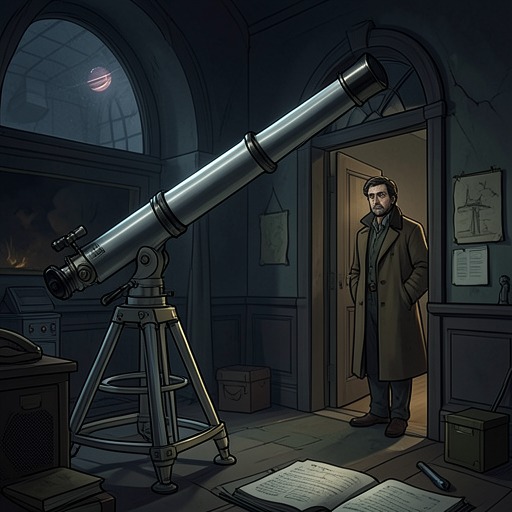
The black stone disappears in transit
The Colour Out of SpaceThe disappearance of the Black stone in transit turns a planned exchange of an ancient object into an unresolved contest over who can control evidence of the unknown. Henry Wentworth Akeley chose an indirect railway route because he feared ordinary channels were being watched; when the consignment failed to arrive, an account of a hypnotically strange man at Keene offered a disturbing lead but no solution. The loss leaves the stone’s hieroglyphs unread and makes the act of transporting knowledge seem as perilous as discovering it.
Background and Stakes
Akeley and Albert N. Wilmarth had been discussing how best to send the Black stone to Arkham. Akeley did not trust an ordinary or predictable route. He had already become wary of the people and signs around his investigations: when he shipped an earlier phonograph record from Brattleboro, he noticed a man at the express office whose interest in the clerks seemed suspicious, and he remained uneasy until Wilmarth confirmed the record had arrived safely. That earlier shipment had carried the recorded forest voices Akeley wanted Wilmarth to hear; the stone, by contrast, promised a different kind of evidence.
The object bore old, blurred hieroglyphs that Wilmarth hoped might yield profound knowledge. Akeley’s caution therefore concerned more than the safe delivery of a parcel. The stone was a material trace of the strange history they were trying to understand, and its loss would cut off the possibility of examining it. Akeley had also warned that the hidden beings and their agents possessed powers ordinary people could not assess, and that curiosity about them could bring danger. His fear of predictable transport routes sat within that larger warning, though the narrative never proves that the beings caused the disappearance.
The Route and the Missing Consignment
Akeley’s final plan was to carry the stone across the county to Bellows Falls and send it on the Boston and Maine railway through Keene, Winchendon, and Fitchburg. The route required him to drive along lonelier, more heavily wooded roads than the main highway to Brattleboro, but he considered it preferable to entrusting the object to a route he regarded as too obvious. On Wednesday, July 18, he telegraphed Wilmarth from Bellows Falls: the stone was being sent on Train No. 5508, leaving at 12:15 p.m. and scheduled to reach Boston’s North Station at 4:12.
Wilmarth expected the shipment to reach Arkham by the following noon and stayed in to receive it. When it failed to appear, he telephoned the local express office, then called the Boston North Station. The train had arrived only thirty-five minutes late, but no box addressed to him had been carried on it. The railway agent promised to investigate, and Wilmarth sent Akeley a night-letter describing the failure. The tight sequence—from telegram to expected delivery, then from one express office to the next—gives the disappearance the shape of a traceable logistical error, even as the missing box frustrates every attempt to locate it.
The Man at Keene
The next afternoon, a Boston agent reported a possible clue from the railway express clerk on Train No. 5508. While the train waited at Keene shortly after one o’clock, a lean, sandy, rustic-looking stranger had argued with the clerk about a heavy box he said he expected. The box was neither on the train nor entered in the company’s books. The stranger gave the name Stanley Adams and spoke in a thick, droning voice that made the clerk feel abnormally dizzy and sleepy. The clerk could not clearly remember how the exchange ended; he recalled becoming more fully awake as the train began to move.
Wilmarth went to Boston to speak to the clerk in person. He found him frank and apparently reliable, but the interview yielded no more than the original account. The clerk was not even sure he could recognize the stranger again. Wilmarth then wrote to Akeley, the express company, the police department, and the Keene station agent, hoping that local witnesses or telegraph records might explain why the man had appeared at that place and time. The stranger’s asserted expectation of a box was especially unsettling because the railway had no record of such a consignment, while the clerk’s altered alertness left the encounter’s ending obscure.
Investigation and Aftermath
The inquiries produced no identification. People at Keene station had noticed the strange-voiced man that afternoon, and one bystander vaguely associated him with a heavy box, but nobody knew who he was or had seen him before or since. No relevant telegram could be found, and he had not visited the telegraph office, so no message was discovered that might have alerted him to the stone’s presence on the train. Akeley joined the investigation and personally questioned people around the station, yet neither his effort nor Wilmarth’s supplied a route from suspicion to proof.
Their responses to the failure diverged. Wilmarth was angry at losing the chance to study the hieroglyphs. Akeley regarded the loss more fatalistically, as a menacing fulfilment of tendencies already at work. He spoke of the hill creatures and their agents as possessing telepathic and hypnotic powers, and hinted that he did not believe the stone remained on Earth. This is Akeley’s inference, not an established account of what happened: the text never shows the stone being taken, identifies the stranger as an agent, or explains how the shipment was intercepted.
The unanswered loss deepens the story’s uncertainty about evidence and its circulation. The earlier phonograph record had reached Wilmarth, but this carefully rerouted parcel did not; the contrast makes transport itself a vulnerable link between observation and knowledge. The Black stone consequently remains inaccessible just when its inscriptions might have offered a way to interpret the surrounding mystery. Akeley’s subsequent letters introduce a more immediate phase of danger around his farmhouse, displacing the failed search with new threats without resolving the missing consignment. The event’s decisive result is thus not a recovered explanation but a broken chain of inquiry: the object, its destination, and the identity of the man at Keene remain uncertain.